Energy monitoring is most useful when it helps a household answer a specific question. A dashboard full of moving lines may look impressive, but it does not explain on its own whether cooling, hot water, pool equipment, cooking or occupancy caused a change. In a Dubai home, the practical approach is to combine the utility view with carefully selected circuit or equipment data and a short record of how the home was used.
This guide shows how to build that process without promising a fixed saving. Our smart-home energy monitoring service can help define the questions, measurement points and handover that belong in a specialist survey.
Begin with one decision, not every possible measurement
Choose the first decision the data should support. You may want to understand why consumption rises while the villa is unoccupied, compare two cooling schedules, identify a large overnight load or check whether pool equipment runs for the intended hours. Each question can require a different measurement and review period.
Write the question in plain language and decide what result would be actionable. “Show all energy” is too broad. “Compare the upstairs AC schedule during two similar occupied weeks” gives the household something it can review. Avoid making several automation changes at once; if lighting, cooling and pool schedules all change together, the dashboard cannot show which change mattered.
Use the utility dashboard as the account baseline
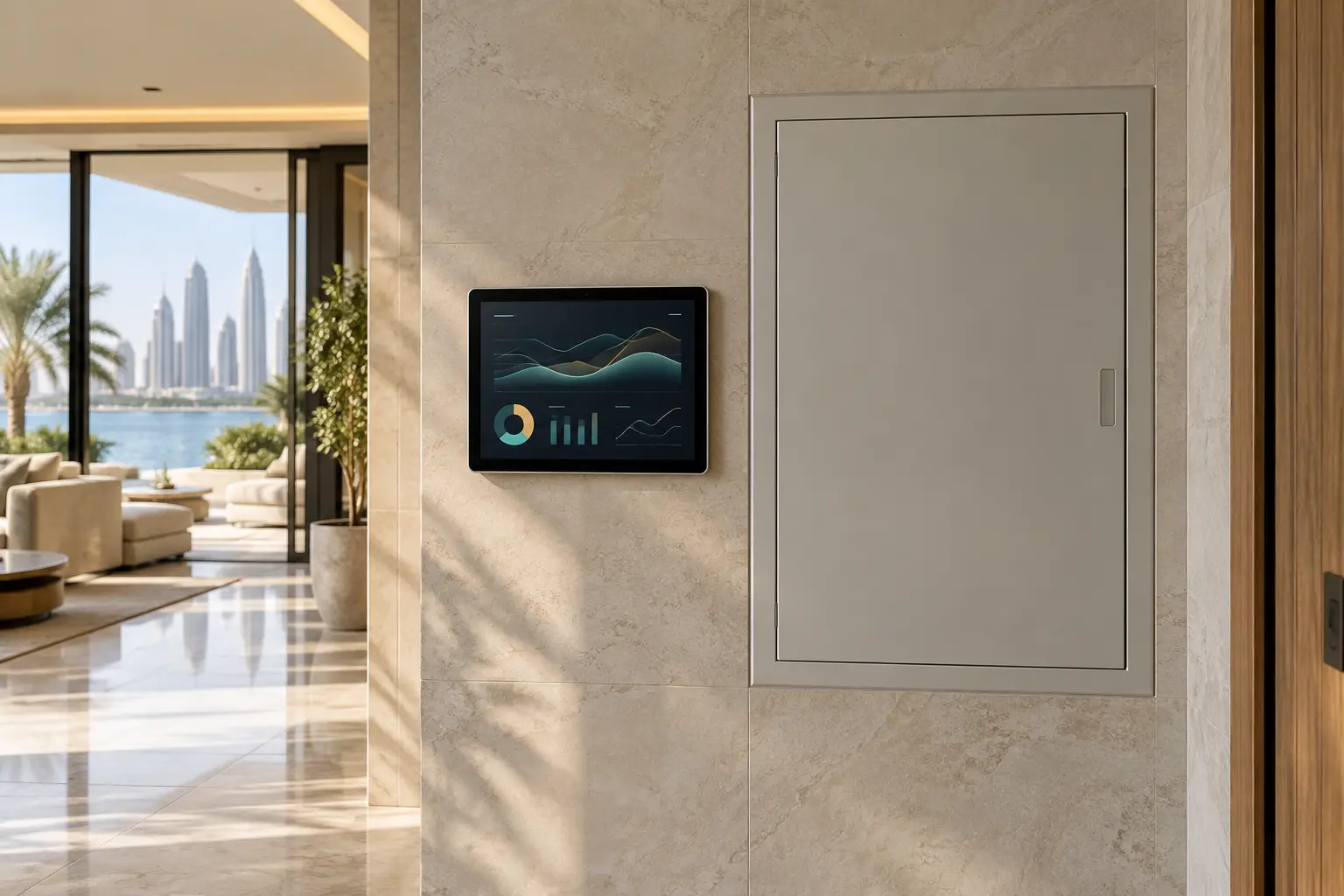
DEWA’s Smart Living information says customers can monitor and compare electricity and water consumption through the website and smart app. Its official page also describes Away Mode and the Consumption Assessment Tool. Start there for the account-level view because it reflects the utility meter and billing context.
The utility view and a home automation dashboard do not have to show the same interval, update time or category. Record the dates and units rather than comparing two screenshots casually. If the totals appear different, first check whether one view covers a day, billing period or rolling interval, and whether it includes the entire premises or only selected monitored circuits.
DEWA’s Consumption Assessment Tool is available to residential customers and provides tailored conservation guidance based on consumption patterns. Use that as an additional official reference, while treating any in-home monitoring as a separate layer whose installation and accuracy depend on the selected equipment.
Decide between whole-home and circuit detail
Whole-home monitoring can show when total demand rises or falls. It cannot reliably name the cause without more context. Circuit-level measurement can separate large groups such as cooling equipment, kitchen loads or pool plant where the electrical design permits it. Device-level data may be available from selected equipment, but different products can report data in different ways.
Ask a qualified electrical specialist to review the distribution boards, phases, available space, access and the exact monitoring hardware. Never open a live panel or attach a consumer sensor without the appropriate professional. The proposal should identify which circuits are measured, what is excluded, how the data reaches the dashboard and how the system is maintained.
Do not assume every circuit label is correct in an existing property. Verification and safe labelling are part of useful commissioning. If one circuit supplies several loads, the dashboard will show their combined behaviour unless the design adds a suitable separate measurement point.
Add context for cooling and occupancy
Cooling can be a major part of the home’s electricity use, but a single high day does not prove that an AC schedule is wrong. Outdoor conditions, setpoints, occupancy, doors, shading, maintenance and the building fabric all influence operation. Compare periods that are similar enough to be meaningful and record obvious differences.
A simple log can contain the date range, occupied or away status, number of active bedrooms, notable events, relevant schedule and any known maintenance. It should not contain private activity details. Use it to explain why two lines may differ before treating the difference as a result.
When reviewing cooling controls, first confirm that the system is compatible and operating correctly. Our smart AC compatibility guide explains why the existing controller and HVAC interface need inspection. Monitoring a fault does not repair it, and aggressive automated switching can reduce comfort or interfere with equipment operation.
Look for patterns before sending alerts
Useful patterns include a base load that continues through the night, repeated peaks at the same time, a load that remains active during Away Mode or a circuit whose run time differs from the agreed schedule. Review several examples before choosing an alert threshold. One unusual event may be a planned household activity, not a fault.
Define the alert recipient and the expected response. “High use detected” is not enough. A useful instruction might ask the owner to check the dashboard, confirm whether the home is occupied and contact the responsible specialist if a named circuit continues outside its expected period. Do not automate disconnection of a critical or unidentified load simply because its consumption changes.
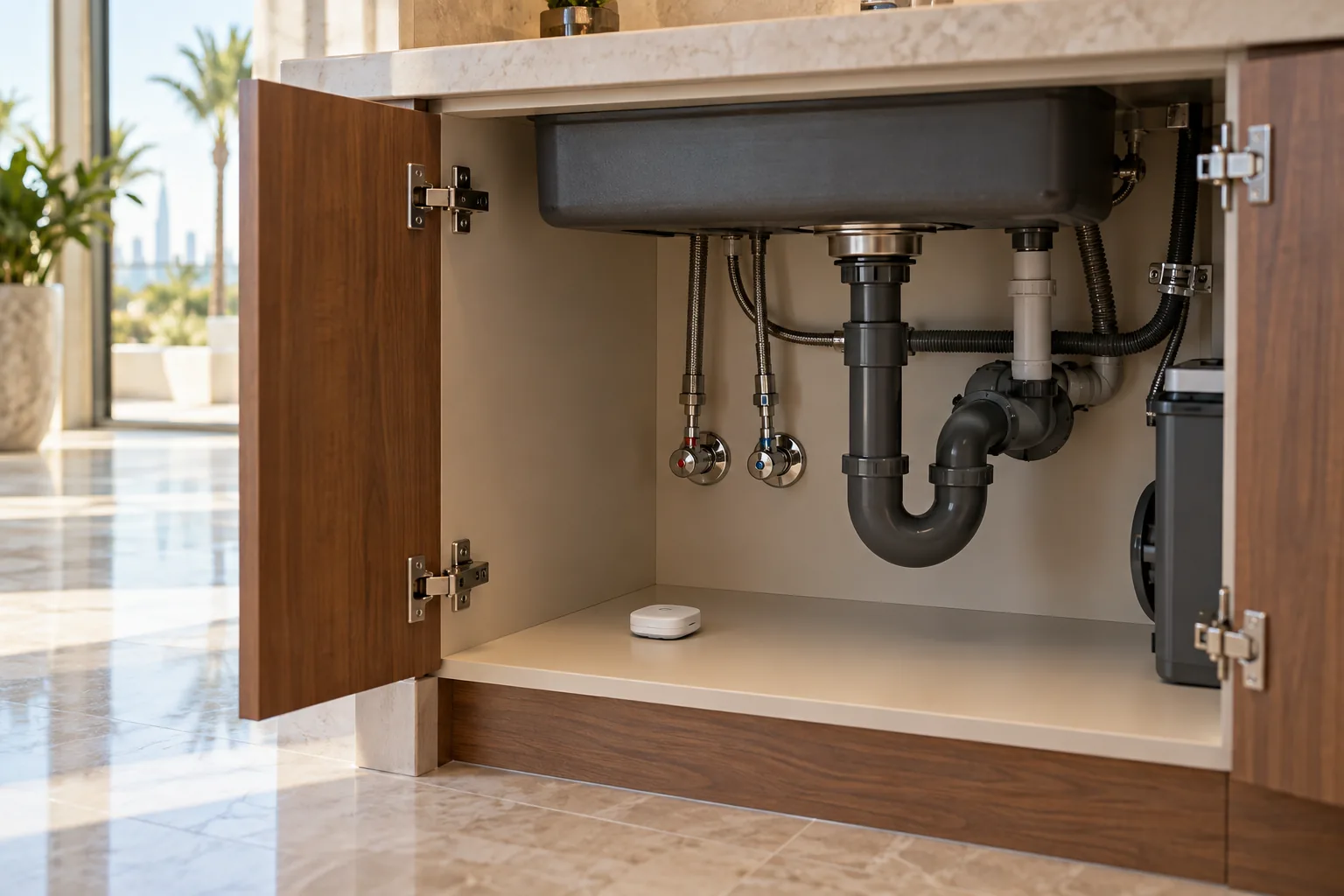
Treat water and electricity alerts as separate processes. DEWA’s Smart Living page describes Away Mode and consumption tools for both utilities, while a point leak sensor has a different location and response path. Our Dubai villa leak-detection guide explains how to assign a responder and test the alert chain.
Run one controlled comparison
Choose a modest change that stays within equipment requirements and household comfort. Examples might include correcting an unintended schedule, turning off a nonessential standby load through its normal control or aligning pool equipment with the specialist’s approved programme. Record the date, keep other major settings stable where practical and review an appropriate period.
Compare like with like. Use the same unit, similar occupancy and a similar time interval. Note weather and exceptional household use. The result may still be inconclusive; that is better than claiming a saving that the data does not support. If a change affects safety, water quality, ventilation, refrigeration or equipment protection, it belongs with the relevant specialist rather than an informal experiment.
Separate a one-off reduction from a repeatable routine. A sustainable automation should be understandable, reversible and tested with the normal physical controls. The homeowner should know how to pause it and who can change it later.
Keep account ownership and data access clear
Decide who owns the utility account, monitoring account and automation administrator account. A support provider may need temporary access, but that does not require permanent shared credentials. Use individual access where the selected platform supports it and remove permissions when the support relationship ends.
Ask where data is stored, how long history remains available and whether exporting a useful record is possible. Cloud subscriptions, gateways and apps may be separate from the electrical measurement hardware. Put recurring fees and replacement responsibilities in the proposal. Do not send account passwords or detailed electrical schedules through a general enquiry form.
Include the monitoring system in the wider smart-home handover checklist. The owner should receive the measurement map, dashboard explanation, alert rules, model details and a secure account handover.
Accept the system using real questions
At commissioning, ask the installer to show the utility baseline, every monitored circuit or device, the data interval and an example alert. Confirm that names match the actual home. Turn an agreed noncritical load on and off through its normal control and check that the expected measurement changes after the documented delay.
Then test Away Mode or the equivalent monitoring view without disabling essential systems. Confirm who receives a notification and what they should do. Record any mismatch between the electrical schedule and the dashboard before sign-off.
A useful energy-monitoring system leaves the household with fewer questions: what is measured, what is not, what changed, who should act and how the result will be checked. It should not replace the utility account, electrical maintenance or qualified diagnosis.
Prepare your monitoring brief
Bring a recent account-level consumption view, the property type, occupancy pattern, known large systems and the two or three questions you want the data to answer. A specialist survey can then assess the electrical boards, equipment interfaces and safe installation scope.
Request a Dubai home energy-monitoring assessment to turn those questions into a measured, clearly handed-over plan.