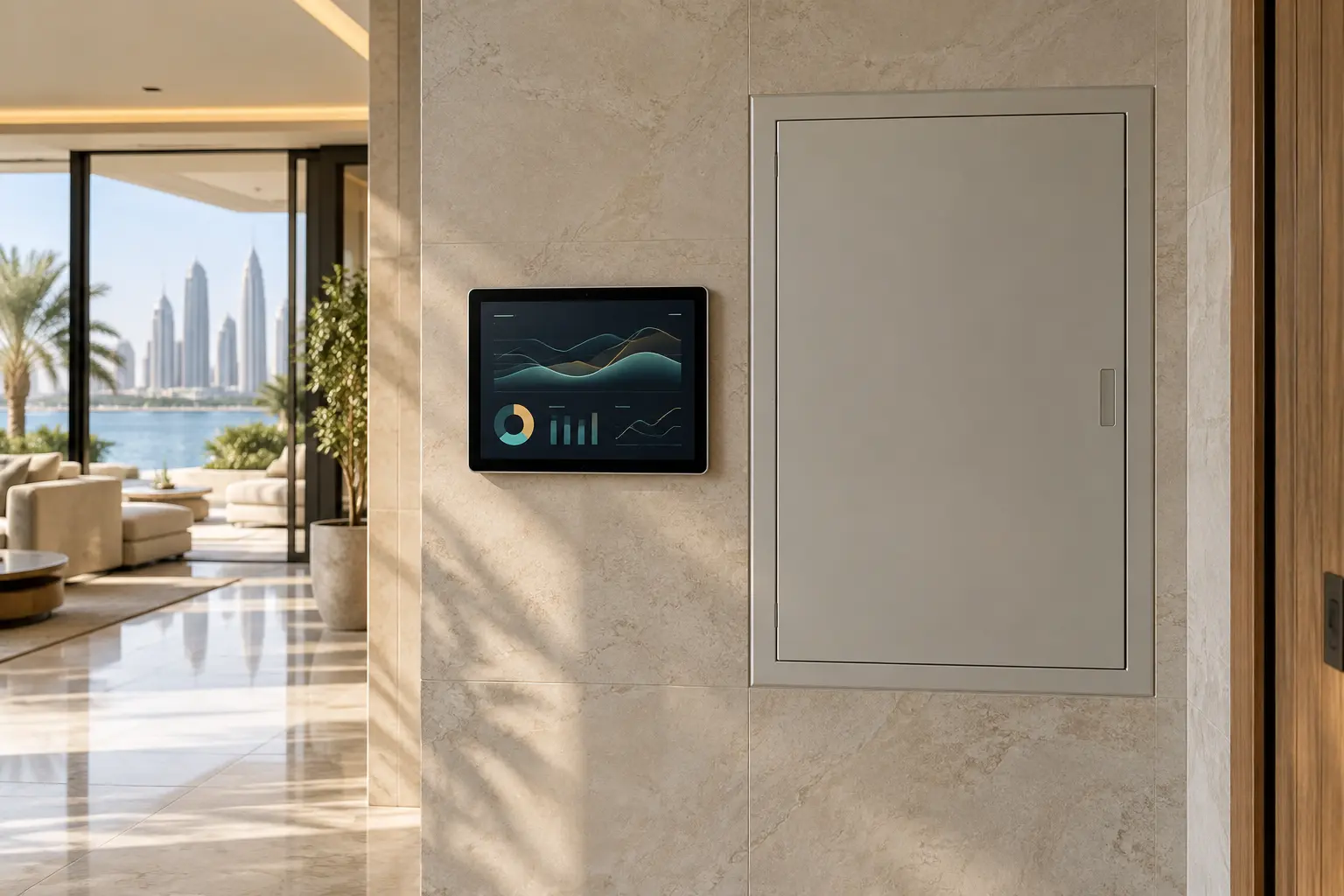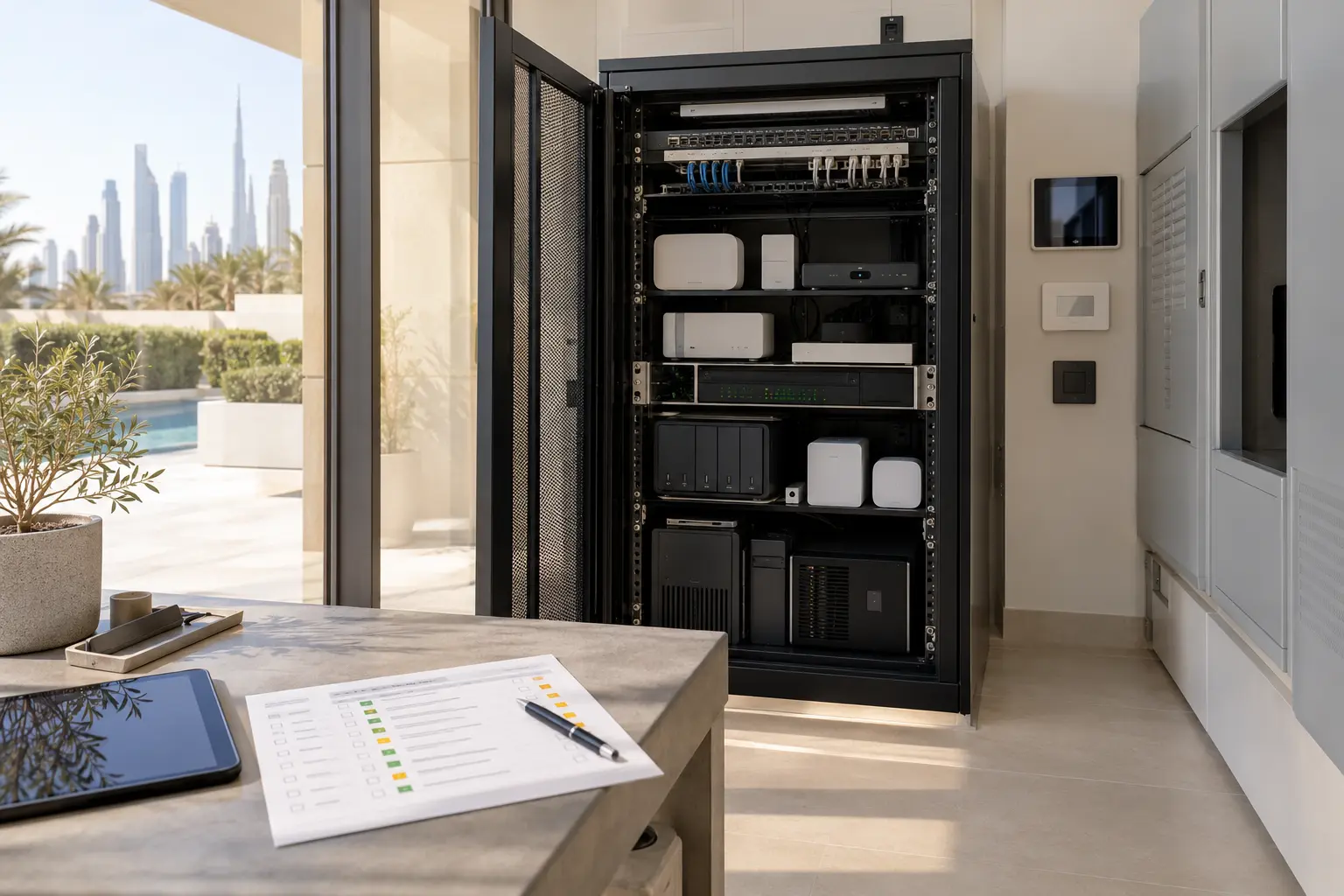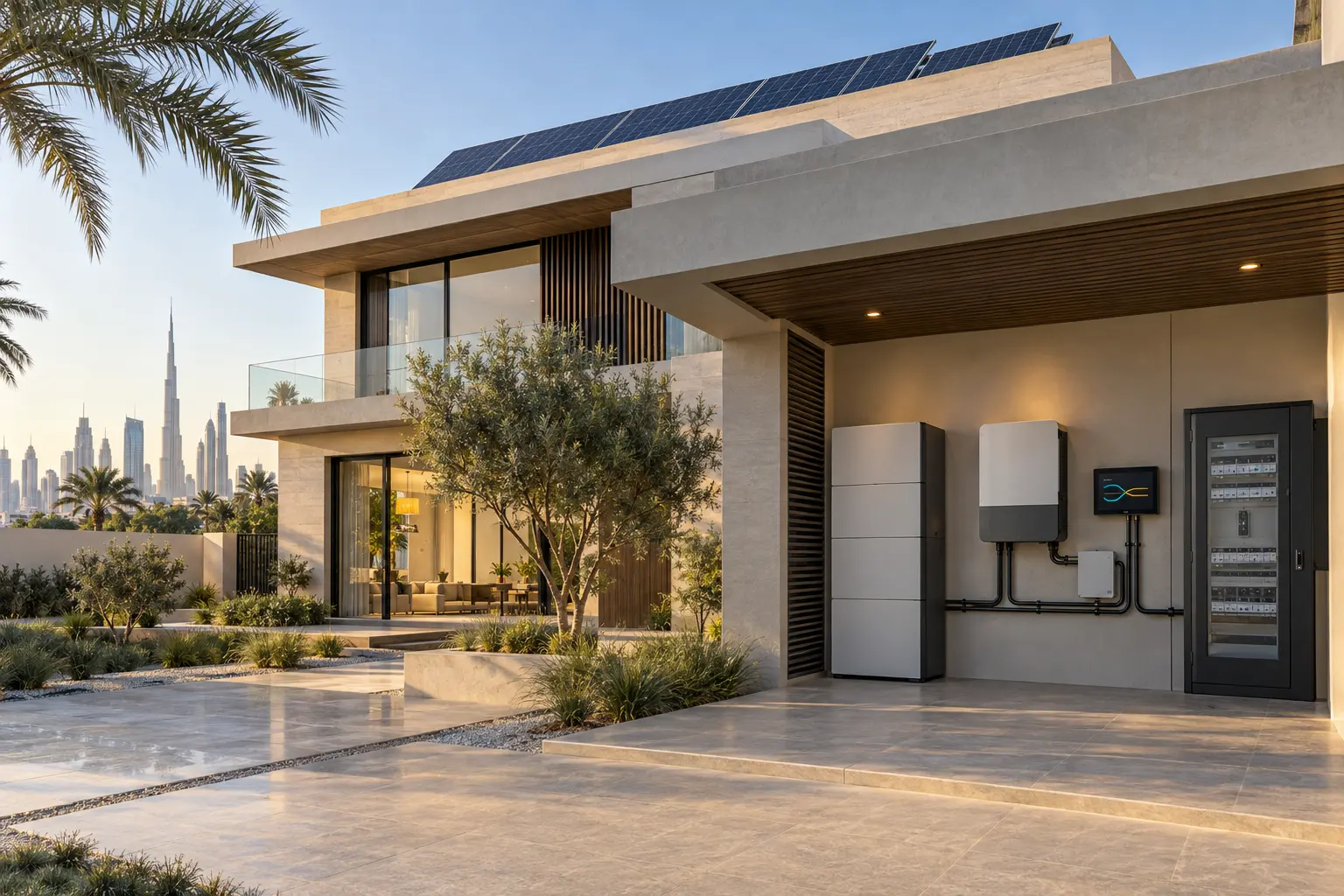
Rooftop solar, a home battery and a smart-home dashboard can all describe energy, but they do not have the same job. The solar contractor owns the photovoltaic design and DEWA connection process. The battery supplier owns storage, protection and backup behaviour. The electrical designer owns circuits and load priorities. The smart-home layer should only display approved data or request documented modes.
This guide helps Dubai villa owners, consultants and fit-out teams define those boundaries before equipment is ordered. Duneva’s smart-energy monitoring service can coordinate the owner brief and approved data interfaces while DEWA-enrolled solar professionals, battery manufacturers and qualified electrical contractors retain responsibility for regulated and safety-critical work.
Separate the project into four layers
Create one diagram with four clear layers: the DEWA connection and metering, the photovoltaic array and inverter, any battery and backup gateway, and the home’s monitoring or automation platform. Name the contractor, equipment, account owner and authoritative data source for each layer.
Do not assume that a solar inverter reading, DEWA meter value and smart-home clamp meter should match at every moment. They may measure at different points, use different intervals and update at different times. Define what each value means before placing it on one screen.
The smart-home system should not issue electrical commands merely because an API exposes a button. Every control point needs written approval, a failure state and an accountable specialist. Monitoring is often useful even when control remains completely separate.
Start with the Shams Dubai process
DEWA’s current Shams Dubai solar FAQ directs customers to enrolled Electrical and DRRG Solar PV consultants or contractors for feasibility, installation, connection and maintenance. It describes a process covering permits and connection, inspection and connection, and generation. Those responsibilities are outside a general smart-home scope.
Ask the enrolled consultant to confirm the usable roof area, structural and civil requirements, shading, installed capacity, approved equipment, inverter position, isolators, cable routes, metering and connection documentation. Coordinate those items with the architect and MEP team before roof finishes, plant screening and service access are fixed.
Keep solar components out of informal owner experimentation. DEWA warns that photovoltaic arrays can remain electrically hazardous when exposed to light and says owners should not interact with system components. The automation team can consume an approved data feed; it should not open equipment or alter the solar design.
Decide whether a battery is actually part of the brief
A grid-connected solar system does not automatically require a battery. DEWA’s FAQ explains that grid-connected systems can feed excess electricity to the distribution grid, while off-grid systems use rechargeable batteries for storage. Treat solar generation, bill offset and backup resilience as separate owner goals.
If storage is proposed, ask the battery specialist to define usable energy, continuous and peak power, backed-up circuits, transfer equipment, reserve settings, ventilation, clearances, ambient limits, communications, fire and authority requirements, and service access. Do not size a battery from the villa’s monthly bill alone.
List the loads the owner expects during an outage: selected lighting, refrigeration, network, access, water systems, medical equipment where applicable, cooling zones, pumps and EV charging. The electrical and battery specialists must decide what can be backed up and what should be shed. The smart-home power-resilience guide provides a framework for critical-path mapping without taking ownership of the battery system.
Define useful data before building a dashboard
Start with owner questions rather than charts. How much power is the villa using now? How much solar is being generated? Is electricity being imported or exported? What is the battery state of charge? Which large load changed the pattern? Is a data source offline or is the electrical system actually unavailable?
For each answer, record the source, units, update interval, expected delay, retention, account owner and offline behaviour. A five-minute cloud value should not be labelled live. A whole-home figure should not be presented as one room’s consumption. If a number is calculated, document the formula and assumptions.
The home-energy monitoring guide explains how to establish a baseline and compare similar conditions without promising savings.
Keep product examples product-specific
Tesla’s current Powerwall overview describes energy monitoring, metering and owner controls through the Tesla app. Its alert documentation also notes that phone and energy products need internet access for push notifications, that notifications may be unavailable during an outage, and that some event features vary by country.
Those are useful examples of questions to ask, not a universal feature list or confirmation of UAE availability. For any proposed battery or inverter, verify the exact model, approved installer, local availability, app region, subscription, API or gateway, firmware, warranty and supported data points.
Coordinate priority loads without unsafe automation
Energy data can inform routines, but comfort and convenience logic must respect electrical limits. For example, the owner may want EV charging, pool heating or non-essential cooling delayed when the villa is on backup. The battery and electrical specialists must define the allowed load-shed method and recovery order.
Do not place an EV charger, large air-conditioning circuit, pump or heater on a generic smart relay. Use approved equipment and interlocks, and ensure local safety controls remain independent. The EV charging, garage and gate guide separates charger load management from gate and smart-home convenience functions.
Test what happens when several large loads start together. Manufacturer guidance for one product may recommend reducing air-conditioning, EV charging or other energy-intensive loads during backup, but the actual villa needs a project-specific load schedule. Never promise a backup duration without the surveyed loads, weather, battery condition and operating choices.
Make alerts truthful and actionable
Create an alert matrix with the event, authoritative source, recipient, action and escalation. Solar-data unavailable, inverter fault, battery low, home on backup, unusually high demand and internet disconnected are different events. A lost cloud connection does not necessarily mean power is unavailable.
Route technical notifications to the owner or appointed facilities contact. Use plain labels and include the correct specialist contact in the private handover record. Do not expose equipment identifiers, network details or daily occupancy patterns in shared notifications.
Keep manufacturer safety and fault alerts within their approved path. A smart-home copy can be supplementary, but it should not silence, replace or reinterpret the original warning.
Plan network, accounts and privacy
Schedule wired network points or approved wireless coverage for inverter, gateway and monitoring equipment, while respecting manufacturer separation and environmental requirements. Record whether data remains available locally when internet service fails. The villa Wi-Fi planning checklist helps coordinate owner-controlled credentials and cabinet capacity.
Decide who owns each account and who may grant installer access. Use individual permissions where supported, remove temporary access after commissioning and document transfer procedures for a future sale or tenancy. Energy patterns can reveal household routines, so limit retention and shared-screen detail to a useful purpose.
Keep API tokens and installer credentials out of drawings, emails and public forms. The handover should show where protected credentials are held without printing them into an unsecured manual.
Commission measurements and failure states
Commission after the solar, battery and electrical specialists have completed their own tests. Compare the approved sources under several conditions: daytime generation with normal loads, low generation, battery charging, battery discharging, grid import, export where applicable and a documented backup test under specialist control.
Confirm units, direction arrows, update delays, date and timezone, tariff assumptions, daily boundaries and historic totals. Disconnect the home dashboard from the network and verify that the solar and battery systems continue their approved operation. Restore power and internet in the documented sequence, then confirm that displays recover without duplicate or misleading alerts.
At handover, retain the DEWA and specialist documents, equipment schedule, single-line diagrams, backed-up circuits, load priorities, data dictionary, account ownership, supported integrations, notification matrix, local fallbacks, maintenance responsibilities and test results. Add approved monitoring equipment to the smart-home maintenance calendar.
Good coordination makes the boundaries visible. Solar generation, battery protection and grid connection remain with the responsible specialists; the owner receives a clear, trustworthy view of energy without turning a convenience dashboard into an unsafe control system.
Request a solar, battery and smart-home data coordination assessment with the villa stage and the appointed solar or electrical consultant. Do not include account passwords, API tokens, meter numbers or electrical security details in the initial enquiry.