An indoor-air dashboard is useful only when the household knows what each reading means, who should investigate it and which specialist system may respond. Temperature, humidity, carbon dioxide, particles and volatile organic compound readings describe different conditions. Combining them into one unexplained colour can hide the decision that matters.
This guide helps Dubai villa owners, designers and fit-out teams prepare a monitoring and ventilation brief without treating consumer sensors as medical devices or building-safety systems. Duneva's water-leak and indoor-comfort planning service can coordinate sensing, owner alerts and suitable ventilation interfaces while the appointed HVAC and environmental specialists retain responsibility for the air system.
Begin with questions, not a device list
Walk the villa room by room and write the question that monitoring should answer. A bedroom may need evidence about overnight comfort. A crowded majlis may need a view of conditions during gatherings. A utility room may need humidity context after washing or drying. A home office may need a trend during long occupied periods.
Record the normal occupancy, door position, air-conditioning schedule, outdoor-air route and activities that may affect the room. Cooking, cleaning products, candles, new furniture and renovation work can create short-term changes. The brief should distinguish a repeatable pattern from a single event before anyone changes the HVAC controls.
Do not install a monitor simply because a platform supports one. Decide who will look at the data, what time range they need and what action is realistic. If no one owns the next step, another graph will not improve the room.
Choose measurements separately
Ask the supplier to list each parameter the proposed device actually measures, its stated range, setup period, update interval and maintenance requirements. Temperature and relative humidity provide comfort and moisture context. Carbon dioxide can help examine occupancy and ventilation patterns in some situations. Particle and volatile-organic-compound sensors have different limitations and sources.
The US EPA's current guidance for low-cost indoor air monitors explains that these devices may measure pollutants such as particulate matter or carbon dioxide and conditions such as temperature and humidity, while also describing limitations. Use readings as evidence for a defined investigation, not as proof that a room is healthy or unhealthy.
Keep smoke and carbon-monoxide alarms separate from convenience monitoring and automation. Life-safety devices, placement, testing and replacement belong to the appropriate approved products and specialists. A smart-home notification must never substitute for the alarm's own local warning.
Treat carbon dioxide as context
Carbon dioxide readings can be useful when compared with occupancy, room use and the known outdoor-air strategy. They do not identify every indoor pollutant and cannot by themselves prove that ventilation is compliant or that air is safe.
EPA's current CO2 and ventilation explanation notes that indoor carbon dioxide can provide information about ventilation but should be interpreted carefully. Ask the HVAC or indoor-environment specialist to establish the appropriate method and project-specific reference. Avoid copying a universal threshold from an app into the villa specification.
If a room repeatedly changes during a known occupied period, record the number of people, door position, HVAC mode and time. That small context log is more useful than a screenshot of a peak with no explanation.
Position sensors for the room being studied
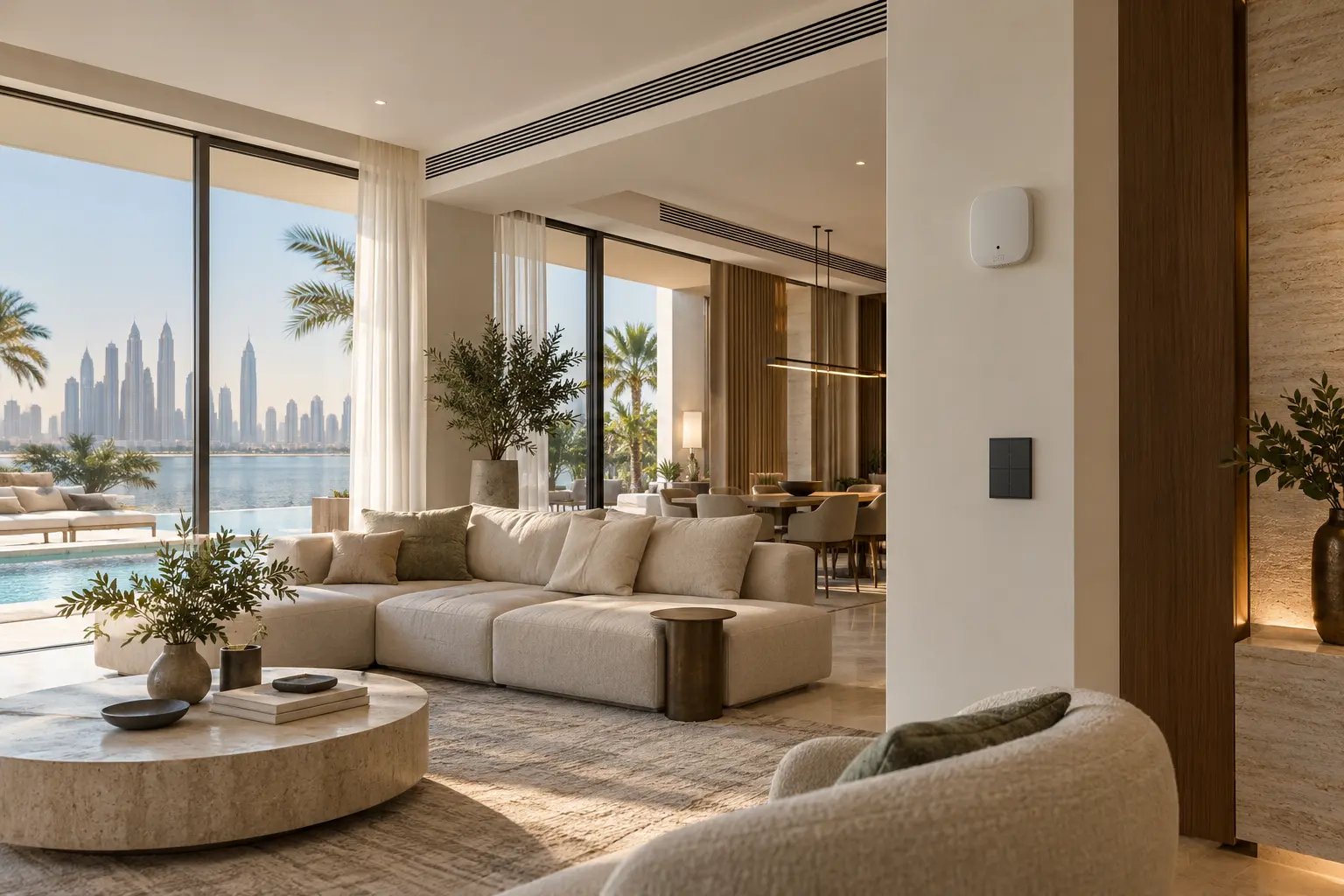
A sensor beside a supply grille, open door, window, cooking source or direct sun may describe that local condition rather than the occupied zone. Mark the proposed position on the furniture and services plan, then confirm mounting height, airflow clearance, power, network coverage and future access.
Do not hide the device behind curtains, inside joinery or immediately against a wall unless the manufacturer permits it. Protect it from cleaning water, impact and locations outside its environmental rating. If the room layout changes, review whether the position still represents the original question.
Some sensors need time to establish a room baseline or acclimatise. Airthings' current Wave Enhance manual is one product-specific example: it distinguishes measurements available immediately from a VOC sensor that needs an initial calibration period. The selected device's own instructions govern its setup; do not transfer one manufacturer's timing or placement rules to another.
Establish a baseline before automating
Collect normal readings across representative occupied and unoccupied periods before creating a ventilation scene. Include weekdays, gatherings, cooking periods and the times when outdoor doors are normally used. Note maintenance or renovation events that make the period unusual.
Compare rooms only when the monitoring method and conditions are comparable. A bedroom, kitchen and double-height living room do not have the same source pattern or airflow. Avoid ranking rooms from one dashboard colour. The aim is to find repeatable relationships that a qualified specialist can investigate.
Keep a simple change log. If a filter is replaced, an air-handling schedule changes or a monitor moves, record the date. Otherwise the graph may appear to improve or decline while the household has forgotten what changed. The smart-home maintenance calendar provides a structure for device reviews and documented changes.
Keep ventilation and filtration with the HVAC design
The automation integrator can display supported data and send an agreed command, but the HVAC specialist must confirm outdoor-air provision, equipment capacity, filtration, pressure relationships, condensate management and control limits. Opening a motorised damper or running a fan because one sensor rose can create comfort, humidity or equipment problems if the air system was not designed for that response.
Daikin Middle East's current residential ventilation overview presents ventilation as part of indoor-air-quality planning. It is manufacturer information, not a project design. The appointed consultant should confirm applicable Dubai requirements and the exact equipment, commissioning and maintenance scope for the property.
Write the boundary clearly: what the monitor observes, what the smart-home platform displays, what the HVAC controller decides and what requires a human review. Keep local HVAC protections and manual service controls intact.
Make alerts restrained and actionable
Start with a small alert schedule. For each parameter, define the room, persistence period, recipient and next review step. A brief change may belong in the history rather than on every phone. A repeated condition over an agreed period may justify asking the responsible specialist to inspect the room and system.
Avoid medical wording and guaranteed outcomes. The message should describe the observation, such as bedroom humidity remained outside the agreed project band, and link to the household response note. It should not diagnose illness, mould or equipment failure from one consumer reading.
Set a separate device-health notification for low battery, lost connection or expired calibration where supported. A silent offline sensor can make a dashboard look reassuring because it stopped reporting. Test notifications on the owner's actual phone and document what happens when the internet is unavailable.
Protect household data and system access
Room occupancy patterns and long-term environmental records can reveal when spaces are used. Decide which household members, property managers and service providers may view history, export data or change alert rules. Use named accounts where the platform supports them and avoid sharing the owner login.
Document whether readings are stored locally, in the manufacturer's cloud or in the automation platform, plus any subscription and retention settings. Confirm current UAE account and service availability before purchase. The voice-control and privacy guide offers a wider framework for household data, microphones and permissions.
Keep detailed room data and account credentials out of a general enquiry. If an environmental or HVAC specialist needs records, export only the relevant period through an approved owner-controlled process.
Commission complete monitoring journeys
Commission each selected room in its finished condition. Confirm the sensor appears under the correct name, readings update as expected, history uses the right time, alerts reach only intended recipients and any approved HVAC interface respects its documented boundary. Then test an offline sensor, owner override and restart using safe methods agreed by the specialists.
At handover, retain the room-question schedule, sensor models and positions, parameters, setup periods, baseline dates, alert rules, data ownership, network and power dependencies, HVAC responsibilities, maintenance instructions and support contacts. Add them to the smart-home handover checklist.
Good indoor-air monitoring makes uncertainty visible. It does not replace ventilation design, professional measurement, alarms or maintenance. Define the question, collect a trustworthy baseline and let every response remain inside the responsible specialist's scope.
Request an indoor-air monitoring and ventilation coordination assessment with the property stage, rooms and current HVAC arrangement. Do not send medical information, passwords or private occupancy records in the initial enquiry.