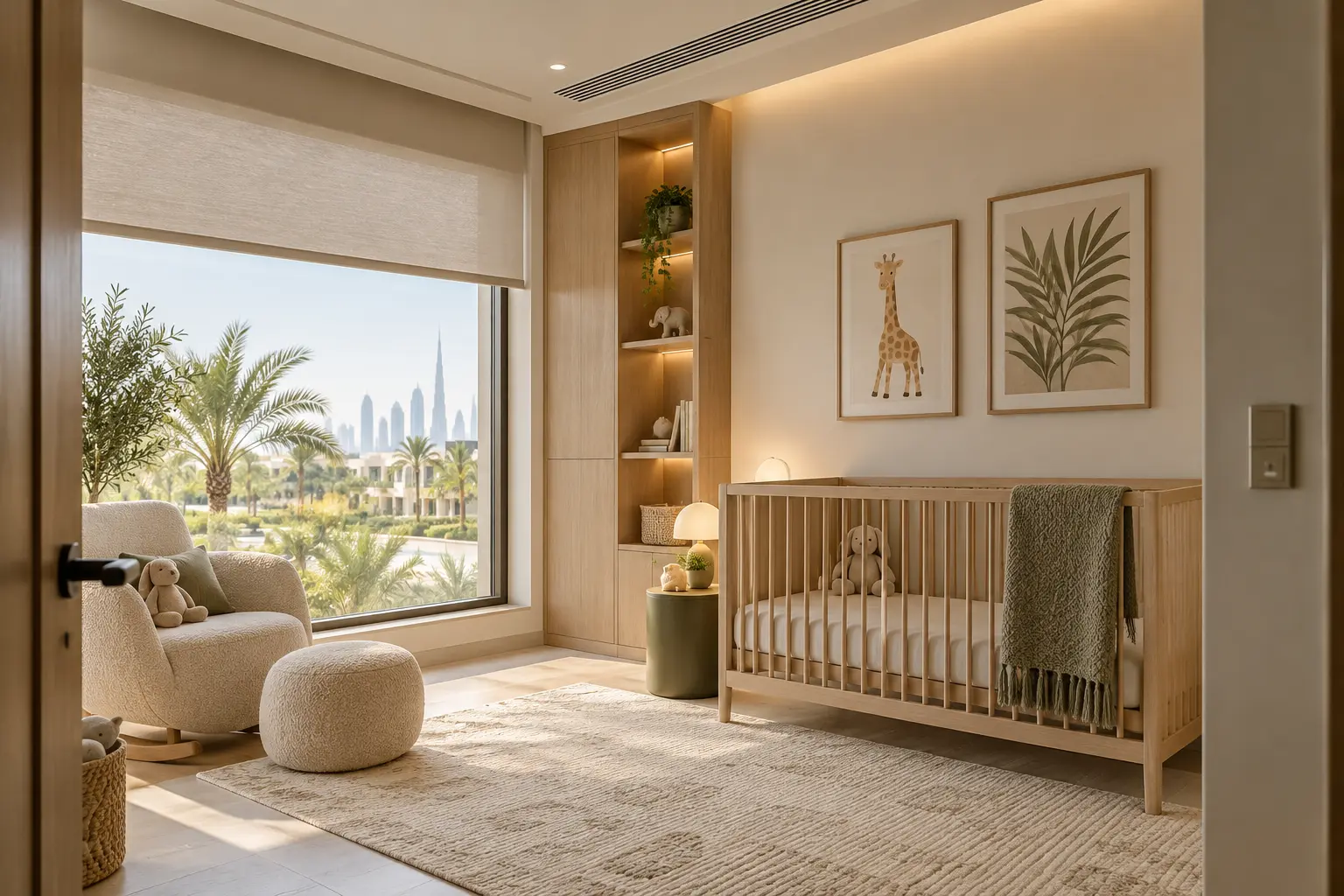
A nursery is one of the few rooms that changes purpose quickly. It may begin with night feeds and daytime naps, become a toddler’s room with independent play, and later need a desk, reading light and different privacy rules. Smart-home planning should support those transitions without making basic light, shade or comfort dependent on an app.
This guide helps Dubai villa owners, interior designers and fit-out teams coordinate lighting, shading, climate, privacy and controls before the room is finished. Duneva’s smart-lighting planning service can organise the control brief and approved interfaces while the electrical, HVAC, window-treatment, joinery and child-safety specialists remain responsible for their work.
Plan for stages, not a single nursery photograph
Start with a simple room timeline: newborn, mobile infant, toddler, school-age child and possible guest-room use. For each stage, record the bed or cot position, changing area, feeding chair, storage, play space, desk, doors, windows and adult circulation. A control that is safely out of reach today may be inconvenient later, while a low touchscreen can become an unwanted toy.
List the household’s real journeys. These might include a quiet night entry, morning preparation, daytime play, reading, cleaning and an all-off check from the corridor. Keep the resulting modes modest. Night Feed, Morning, Play, Reading and Off are clearer than dozens of device controls.
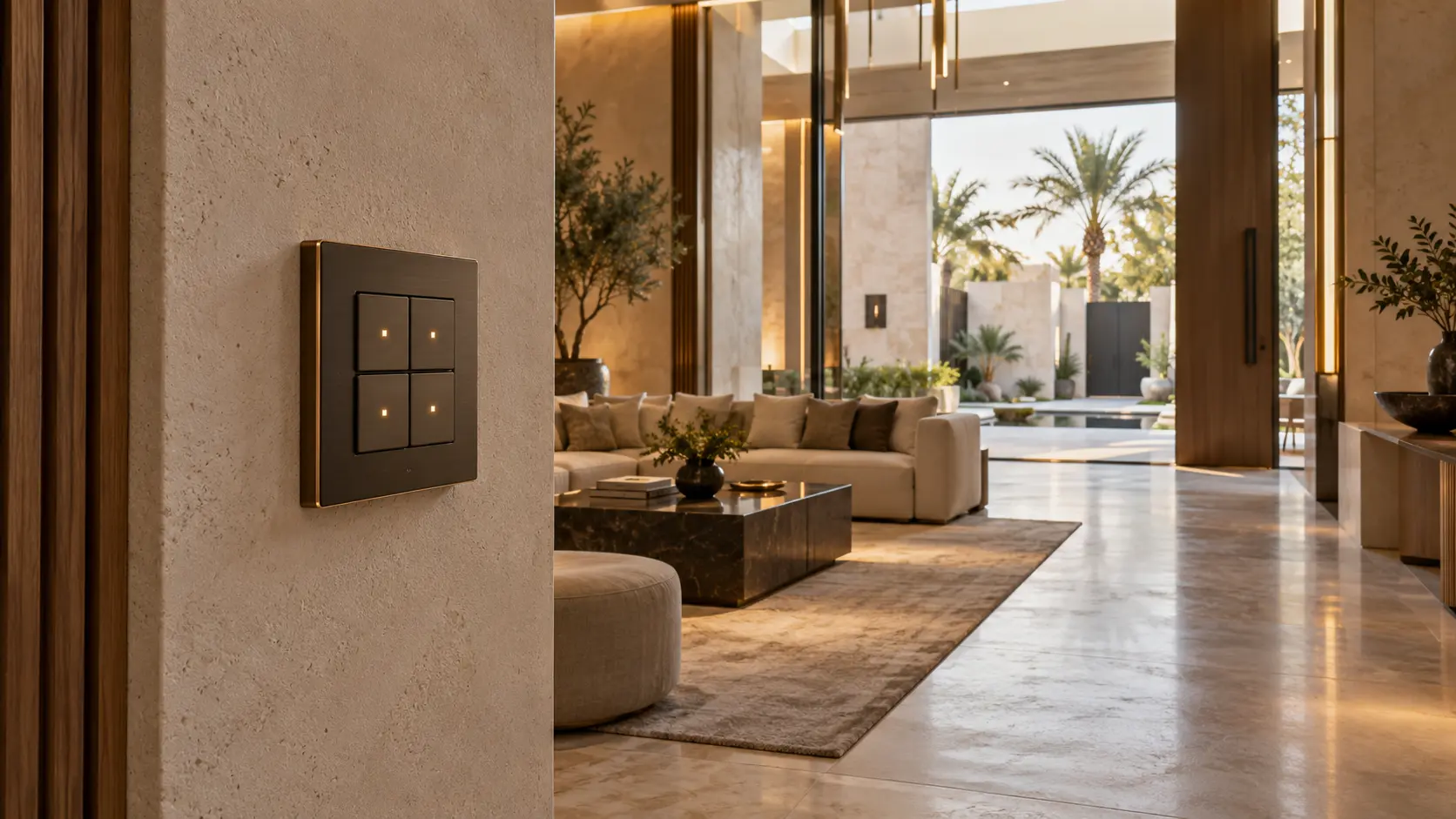
Decide what must always remain physical. The main room light, a low-level night light and shade control should be understandable to another caregiver without a phone, account or explanation. The smart-home keypad planning guide provides a useful method for testing labels before engraving.
Treat window coverings as a safety decision first
The window, cot and furniture plan must be coordinated before selecting a motor or fabric. The US Consumer Product Safety Commission’s current window-covering cord guidance says the safest option where young children are present is cordless and advises moving cots, beds, furniture and toys away from window-covering cords. Apply the selected product’s instructions and the project’s local requirements rather than relying on automation alone.
A motorized treatment can remove a normal operating cord, but the complete installation still needs a safety review. Check side channels, hem bars, accessible gaps, furniture placement, control height, pocket access and the path of every moving element. Never place a cot, shelf or toy storage where a child can reach or obstruct the shade.
Keep a local stop or reversal method where the chosen system supports it. Do not schedule movement that could surprise a child or caregiver. A morning-open routine should respect privacy and be disabled when the room layout, furniture or use changes. The motorized-curtain pocket guide helps coordinate power, access and final travel limits.
Make lighting calm, useful and easy to override
Separate the room into useful layers: general light, a low-level night route, changing or care light, reading light and wardrobe or storage light. The exact fittings, colour quality, dimming range and heat must be confirmed by the lighting designer. Automation should coordinate those layers, not compensate for poor placement.
Night routines usually benefit from restraint. A corridor button can bring on a low route before the door opens; the main keypad can then offer a brighter task level if needed. Avoid a routine that turns on every ceiling light because one sensor detects movement.
Give adults immediate manual control. A caregiver should be able to raise, lower or switch off the light without opening an app or speaking near a sleeping child. If the room later becomes a study space, the same wiring and keypad can support a brighter task scene without rebuilding the control system. The smart-bedroom comfort guide offers a related framework for bedside controls, blackout and night-time commissioning.
Choose sensor behaviour deliberately
Presence sensors can help with brief visits, but they should not decide the whole room. A sleeping child, a seated caregiver or somebody reading may move very little. Test sensor coverage and timeout with finished furniture and the actual activities, not an empty construction room.
Lutron’s current Maestro sensor guidance distinguishes automatic-on/automatic-off occupancy mode from manual-on/automatic-off vacancy mode. That is a product-specific example, not a universal recommendation. For a nursery, manual-on with automatic-off may avoid an unexpected bright light while still preventing a light being left on after the room is empty.
Document the selected mode, sensitivity, timeout and controlled loads. Keep storage-door sensors separate from room presence where practical. Re-test after the cot becomes a bed or the room gains a desk, because furniture and normal behaviour affect detection.
Keep climate and air-quality responsibilities clear
Dubai cooling makes room comfort important, but the smart-home system should only request settings that the appointed HVAC specialist approves. Confirm the actual zone, thermostat position, supply and return paths, door undercut, minimum airflow and allowed setpoint range. A decorative room sensor does not prove that the cot receives the same conditions.
If temperature, humidity or carbon-dioxide data are displayed, agree what action each reading supports and where the measurement is valid. Avoid medical promises and alarm thresholds copied from another building. The indoor-air-quality and ventilation guide explains how to establish room-specific baselines and keep ventilation responsibility with the HVAC team.
Do not automate portable heaters, bottle warmers, sterilisers or other heat-producing childcare equipment through generic smart plugs. Follow each manufacturer’s instructions and keep hazardous or high-load devices outside casual scenes.
Minimise cameras, microphones and shared data
Decide first whether a camera or audio monitor is genuinely needed. Record its view, account owner, permitted viewers, retention, notifications, cloud dependency and removal date. Keep changing areas and unnecessary parts of the room out of view. Household staff or guests should not inherit access simply because they can control the lights.
Apple’s HomeKit camera-security documentation describes one platform’s encrypted processing and optional face-classification data. That does not make every camera private or appropriate. Confirm the exact product, account, subscription, region, network and retention settings, then give owners a clear way to revoke access.
Voice control also deserves restraint. Avoid commands that reveal a child’s routine on shared speakers, and retain physical controls for every essential action. Review the voice-control and privacy guide before adding microphones or personal profiles.
Plan offline operation and useful alerts
The room’s essential lighting and shade controls should remain usable if the internet or voice service is unavailable. Document what happens if the home controller, wireless network or a sensor battery fails. A night route should not disappear because a cloud account expired.
Use alerts sparingly. A low sensor battery or equipment fault can go to the owner or facilities contact; ordinary movement should not notify the whole household. Never present a smart-home alert as a substitute for responsible supervision, a life-safety device or professional advice.
Add room controls, batteries, shade travel, account access and sensor tests to the smart-home maintenance calendar. Keep recovery instructions with the household handover rather than inside a private chat history.
Commission with real furniture and repeat as the child grows
Test Night Entry, Night Feed, Morning, Play, Reading, Cleaning and Off after curtains, rugs, furniture and storage are installed. Check manual controls, dimming, glare, shade movement, sensor timeout, privacy, network loss and power restoration. Ask a caregiver who did not program the system to use every essential function.
At handover, retain the room plan, circuits, lighting channels, shade limits, sensor settings, HVAC boundary, device accounts, permitted viewers, offline behaviour and maintenance tasks. Schedule a review when the cot becomes a bed, furniture moves or the room becomes a study.
A well-planned smart nursery feels ordinary in the best way: adults can see and move comfortably, controls are predictable, privacy is deliberate and the room can mature without losing its simplest functions.
Request a nursery and children’s-room planning assessment with the villa stage and room layout. Do not include camera credentials, access codes, children’s names or private routines in the initial enquiry.